

Embassies, Consulates, and Certified Translation: The Complete Guide to Everything You Need to Know Before Submitting Your Documents | Questions & AnswersIf you are preparing to travel, immigrate, study abroad, or even authenticate your documents for use outside Egypt, then you have certainly dealt with, or will eventually deal with, a foreign embassy or consulate at some point.And this is where the questions begin.What is the difference between an embassy and a consulate?Will an embassy accept any translation?Do I need a certified translation?Can an application be rejected because of a simple mistake?Do all embassies require the same documents?Do the requirements of the Canadian Embassy differ from those of the United States Embassy, the United Kingdom Embassy, or Schengen countries?Is it necessary to translate a birth certificate?What about a marriage certificate or academic certificates?And what if the documents are translated but not certified?The truth is that dealing with embassies is not limited to preparing documents only; it also requires a high degree of accuracy in preparing and translating documents according to the requirements of each authority.For this reason, Middle East Institute has become one of the specialized providers of certified translation services for embassies, consulates, and immigration authorities inside and outside Egypt, with more than 15 years of experience handling various types of official files.In this comprehensive guide, we will answer the most common questions people ask before submitting their documents to embassies.
—Q1: What Is an Embassy?
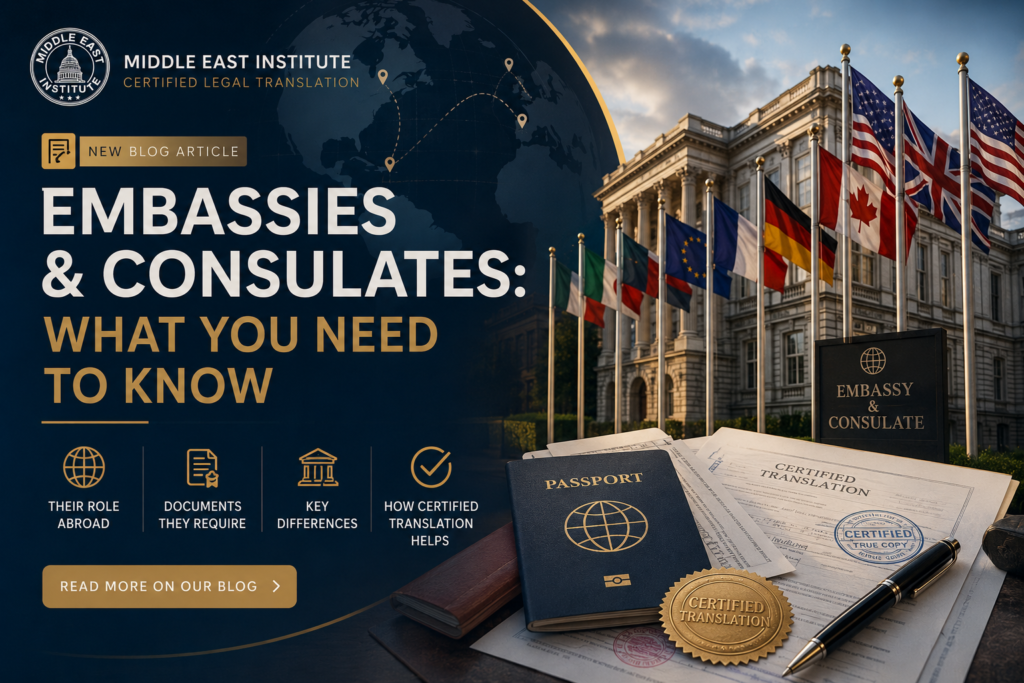
An embassy is the official representation of one country within another country.For example, the Embassy of Canada in Egypt represents the Canadian government within Egyptian territory, as do the U.S. Embassy, the British Embassy, the Italian Embassy, and others.Embassies are responsible for many tasks related to visas, immigration, document authentication, diplomatic relations, and consular services. Due to the direct connection between embassies and official documents, the Middle East Institute team deals daily with translating documents required for submission to numerous embassies and consulates, giving clients practical expertise built on years of experience handling the requirements of various international authorities.
—Q2: What Is the Difference Between an Embassy and a Consulate?
An embassy officially represents a country and is usually located in the capital city.A consulate, on the other hand, provides direct services to citizens, such as issuing certain documents, certifications, and various consular services.In many cases, people use the terms embassy and consulate interchangeably despite the administrative differences between them.
—Q3: Why Do Embassies Require Document Translation?
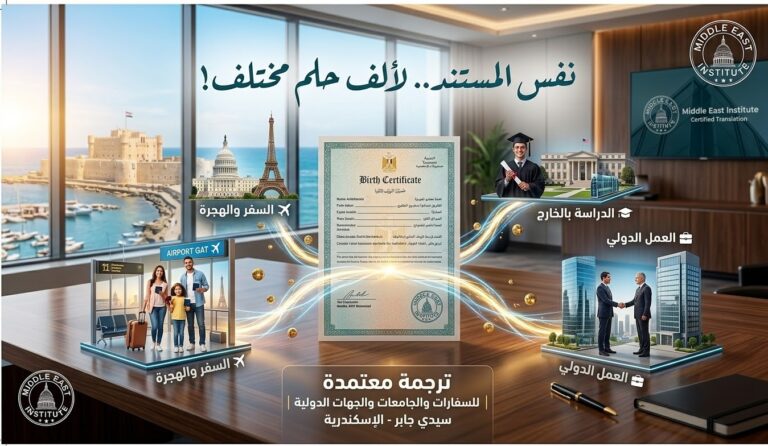
Because most embassies do not accept documents written in a foreign language from their perspective.For example, when a birth certificate written in Arabic is submitted to a foreign authority, the responsible officer will not be able to officially review its contents unless it has been translated through a certified translation.Therefore, many embassies require certified translations for official documents.For this reason, many embassy applicants rely on Middle East Institute as a certified translation office in Alexandria with extensive experience in preparing and translating official documents according to the requirements of many embassies and international authorities.
Q4: What Is Meant by Certified Translation for Embassies?
A certified translation is an official translation issued by a certified translation office, carrying the office’s details, stamp, and accreditation, allowing it to be used before embassies, consulates, and international authorities.For this reason, ordinary translation or personal translation is not sufficient for most official files. At Middle East Institute, certified translations are prepared according to precise professional standards, with careful review of data, names, dates, and legal terminology to ensure documents are ready for use before embassies, consulates, and official authorities.
Q5: Do All Embassies Require Certified Translation?
In most cases, yes.Especially when it comes to:- Birth certificates.- Marriage certificates.- Divorce certificates.- University degrees.- Academic transcripts.- Commercial registrations.- Legal documents.- Court judgments.- Medical reports.Based on more than 15 years of experience at Middle East Institute, certified translation requirements have become an essential part of the majority of files submitted to embassies, immigration authorities, and international universities.
—Q6: Do All Embassies Have the Same Translation Requirements?
No.This is one of the most common misconceptions.The requirements of the Canadian Embassy may differ from those of the U.S. Embassy.Likewise, the requirements of some Schengen embassies may vary from one country to another.Therefore, it is important to work with a provider that has experience in certified translation for different embassies.For this reason, the Middle East Institute team carefully reviews the nature of each file and the receiving authority before beginning the translation process, ensuring that documents align with the required standards whenever possible.
—-Q7: Can an Application Be Rejected Because of a Translation Error?
Yes.In some cases, an error in:- A name.- Date of birth.- Passport number.- Job title.- Legal terminology.may result in a request for retranslation, delays in procedures, or rejection of the application until the error is corrected.For this reason, Middle East Institute relies on specialized translators and multiple review stages to minimize the possibility of errors and ensure the highest levels of accuracy in translating official documents.
—Q8: What Are the Most Common Documents Embassies Require to Be Translated?
The most commonly requested documents include:- Birth certificate.- Death certificate.- Marriage certificate.- Divorce certificate.- Academic qualifications.- Academic transcript.- Criminal record certificate.- Commercial registration.- Tax card.- Medical reports.- Legal contracts.These documents are among the records that Middle East Institute handles on a daily basis as part of its certified translation services for embassies, consulates, and immigration authorities.
—Q9: Do the Translation Requirements for Studying Abroad Differ?
Yes.Universities and embassies typically require the translation of:- Academic certificates.- Academic transcripts.- Recommendation letters.- Experience certificates.- Curriculum vitae (CV).All of these documents must be translated professionally and accurately.Middle East Institute has assisted many students in preparing and translating the academic documents required for admission to universities and educational programs outside Egypt.
—Q10: What About Immigration Files?
Immigration files are among the most sensitive types of files.They require a high degree of accuracy in translating all supporting documents and records.For this reason, large numbers of immigration applicants rely on specialized offices such as Middle East Institute to ensure that their documents comply with the requirements of the relevant authorities.Immigration files are one of the fields in which Middle East Institute possesses extensive experience thanks to its continuous work with the requirements of authorities such as Canada’s IRCC and the United States’ USCIS, as well as other international authorities.
—Q11: Do the Requirements of the Canadian Embassy Differ from Those of the United States Embassy?
In many cases, yes.Each authority has its own procedures, forms, and requirements.However, the common factor is always the importance of providing accurate and certified translations of the required documents.
—Q12: Which International Authorities Deal with Certified Translation?
Among the most prominent authorities are:- Canada’s IRCC.- The United States’ USCIS.- Foreign embassies.- Consulates.- International universities.- Foreign government authorities.Middle East Institute is proud to provide certified translation services that are used in files submitted to many of these international authorities and various embassies.
—Q13: Why Do Many Clients Choose Middle East Institute?
Because the institution combines several important advantages:- More than 15 years of experience.- Specialization in certified translation for embassies.- Certified translation for immigration files.- Specialized legal translation.- Academic accreditation in legal translation.- Accredited member of the Arab Translators Association.- Fast turnaround times of up to 24 hours for most documents.
—Q14: Does the Institution Provide Translation Services for All Languages?
Yes.Middle East Institute provides certified translation services for a wide range of international languages, in addition to a large number of rare languages.This helps clients complete all their requirements from one place.It also enables Middle East Institute clients to obtain certified translation services for all their needs through a single provider without the need to deal with multiple offices.
—Q15: Is Confidentiality Important When Translating Embassy Files?
Absolutely.Because files often contain:- Personal information.- Financial information.- Legal contracts.- Family documents.- Medical reports.Therefore, they are handled with the highest levels of confidentiality and privacy.For this reason, Middle East Institute is committed to the highest standards of professional confidentiality when dealing with all official and personal files and documents.
—Q16: Can Documents Be Sent Online?
Yes.Many clients prefer to send their documents electronically for an initial review and to determine the cost and turnaround time before visiting the office.This has helped Middle East Institute clients both inside and outside Alexandria obtain certified translation services quickly and efficiently.
—Q17: What Are the Most Common Mistakes Made by Embassy Applicants?
Some of the most common mistakes include:- Submitting a non-certified translation.- Inaccurate translation of names.- Inconsistencies between documents.- Using an old translation that contains errors.- Failing to review documents before submission.For this reason, the Middle East Institute team always recommends reviewing and translating documents through a specialized provider before submitting them to embassies or international immigration authorities.
—Q18: Is Certified Translation an Investment or an Additional Expense?
In reality, it is an investment.The cost of repeating procedures, postponing an embassy appointment, or rebuilding an application file can be much higher than the cost of obtaining a proper certified translation from the beginning.The Middle East Institute team believes that accurate translation from the outset saves clients significant time, effort, and potential costs resulting from repeated procedures or delayed applications.
—Q19: Why Is Experience Important in Translating Embassy Files?
Because a translator does not deal only with words.They deal with legal and official documents that may affect the future of an individual, a family, or an entire company.Therefore, extensive experience in dealing with embassies, consulates, and immigration authorities is an extremely important factor.This is what has made Middle East Institute’s more than 15 years of experience a key element in providing certified translation services for official and legal documents.
—Q20: How Do I Choose the Best Certified Translation Office for Embassies in Alexandria?
Look for a provider that has:- Extensive experience.- Academic accreditation.- Acceptance by embassies.- Experience with immigration files.- Specialized translators.- Commitment to confidentiality.- Fast turnaround times.These are the standards that have made Middle East Institute one of the recognized names in the field of certified translation in Alexandria and Egypt.—If you are looking for a certified translation office in Alexandria, a certified translation office in Sidi Gaber, certified translation services for embassies, certified translation for immigration, or translation of academic certificates, legal contracts, and official documents, Middle East Institute provides a comprehensive range of certified translation services built on experience, accuracy, speed, and confidentiality.ConclusionWhether you are preparing to apply for a visa, immigrate, study abroad, or authenticate your official documents, certified translation is an essential step that cannot be overlooked.At Middle East Institute, we bring more than 15 years of experience in serving our clients, with a commitment to the highest standards of accuracy, confidentiality, and quality, providing certified translations accepted by numerous embassies, consulates, and international authorities.If you are looking for a certified translation office in Alexandria, need certified translation services for embassies, or require translation for immigration, study abroad, or international employment files, Middle East Institute is ready to assist you every step of the way.📍 Middle East Institute Location on Google Maps:
https://share.google/Uxa5QyzPGHTU8OTWK
Middle East Institute – مكتب ترجمة معتمدة في الأسكندرية https://share.google/Uxa5QyzPGHTU8OTWK
Middle East Institute | Certified Translation Office in Alexandria | Sidi Gaber | Certified Translation for Embassies | Certified Translation for Immigration | Legal Translation | Translation of Academic Certificates and Official Documents | Certified Translation for Study Abroad Files | Certified Translation for International Immigration Authorities.